

What Is Emotional Regulation?
Emotional regulation is when we notice our emotions and try to understand what they may be communicating through our body. To support our emotions and avoid feeling overwhelmed, our system needs helpful strategies. Importantly, these strategies can:
- reduce unpleasant emotions, overwhelming or negative feelings
- increase an emotion that is too low
- maintain an appropriate level of emotion
- help in tolerating a strong emotion without being controlled by it, and also acting more intentionally while the emotion is still present.
Emotional regulation recognises what is happening, interprets it, creates a suitable response, and monitors whether that response is helping. Regulation can be conscious or automatic and can occur independently or through co-regulation with another person.
Why Regulating Emotions Can Be More Challenging for Some People?
Regulating emotions can be more challenging when a person experiences sensory overload, communication barriers, difficulty recognising internal feelings, unexpected changes, pain, trauma or environments that feel unpredictable or unsafe. This does not mean the person is incapable of emotional regulation, only that they may need more personalised support. For some autistic people and people with a learning disability, or people experiencing behaviours of concern, distress may build before they can recognise, communicate or respond to it.

Emotional regulation is not a different human process in people who require complex care. The underlying purpose of emotional regulation is the same, but the conditions required to achieve it and the ways distress is experienced, communicated, and supported may be significantly different. Emotional dysregulation occurs when the intensity, duration or expression of emotion becomes difficult for the person to manage in that situation. It is not the presence of a strong emotion itself.
However, for some people who require complex care, regulation may:
- be placed under greater pressure by sensory, communication, cognitive, physical-health and environmental factors
- develop or operate differently
- be expressed in less conventional or less easily recognised ways
- depend more heavily on supportive relationships, accessible communication and a well-matched environment
Read more about Autism and Anxiety in Adults.
Why Emotional Regulation Can Be Difficult
Emotional regulation is the ability to recognise, understand and manage emotions in ways that support wellbeing and everyday life. This process may be affected by communication needs, sensory differences, unexpected change, trauma, anxiety or other mental health challenges. For some autistic people and people with a learning disability, it is not easy to come up with specific strategies on their own that can help them regulate negative emotions at home. Practising deep breaths without support may be impossible.
Communication Differences
A person may experience strong or difficult emotions without having an accessible way to identify or communicate them. They may find it difficult to describe their own emotions, explain what has caused them or ask for help before distress escalates.
Their emotional responses may instead be expressed through withdrawal, changes in communication, repetitive movement, attempts to leave, self-injury or other behaviours of concern. Accessible communication can support self-regulation by helping the person express discomfort, request a break and communicate what they need.
Sensory Processing Differences
Sounds, lighting, touch, smells, crowds or other sensory experiences can place significant pressure on the nervous system. When sensory demands accumulate, the person can easily become overwhelmed and find it increasingly difficult to manage emotions.
Sensory overload can sometimes be mistaken for an excessive emotional reaction. However, the person may be responding to an environment that has become physically and emotionally unbearable. Appropriate sensory adjustments and individualised emotion regulation techniques can help reduce this pressure.
Changes in Routine
Predictable routines can create safety, understanding and a sense of control in one’s living space. An unexpected change, unfamiliar person or unclear transition may therefore produce anxiety or distress, particularly when the person has not been given enough information or time to prepare.
Visual information, advance notice, meaningful choices and consistent support can make change more manageable while helping the person develop flexible self-regulation strategies.
Trauma, Anxiety, and Mental Health
Previous experiences of abuse, neglect, restraint, rejection, repeated misunderstanding or loss of control can affect how the nervous system responds to current situations. A person may react strongly to an environment, interaction or demand that reminds them of an earlier experience, even when the connection is not immediately apparent to others.
Trauma-informed support seeks to understand the reasons behind emotional reactions and create greater safety, trust, choice and control. Anxiety, depression and other mental health challenges can intensify negative emotions or make them last longer. They can also reduce the person’s ability to access familiar coping strategies and respond to everyday demands. Also, changes in behaviour should not automatically be attributed to autism or a learning disability. They may indicate emotional distress, mental ill health, physical discomfort or another unmet need that requires assessment and support.
Practical Emotional Regulation Strategies at Home
Emotional regulation support at home does not have to begin with a complicated programme. Often, the most effective strategies are woven into everyday life: a quieter place to recover, a simple way to communicate feelings or greater certainty about what will happen next. The important thing is to discover what helps the person and not what is generally considered calming.
Create a Calm Space
A calm space within the home should feel like a retreat, not a place someone is sent when their emotions become difficult to manage. It could be the bedroom corner, a small den, a garden/balcony space or simply a familiar chair. What matters is that the person can control as much of the sensory environment as possible, including light, sound, temperature, smell and proximity to other people.

Build the space with them. Depending on their preferences, it might contain:
- headphones or ear defenders
- cushions, blankets, or comfortable clothing
- familiar books, music, or meaningful objects
- sensory items they have chosen
- access to a favourite interest
- a visual sign showing that they need uninterrupted time
A UK study involving autistic adults found that protected time and space alone could help people retreat from sensory and social overwhelm, regulate, recover and eventually feel ready to reconnect. Participants valued spaces that felt familiar and safe and where sensory input could be controlled. The space should remain available before, during and after distress, and never used as punishment or forced isolation.
Regular Feelings Check-ins
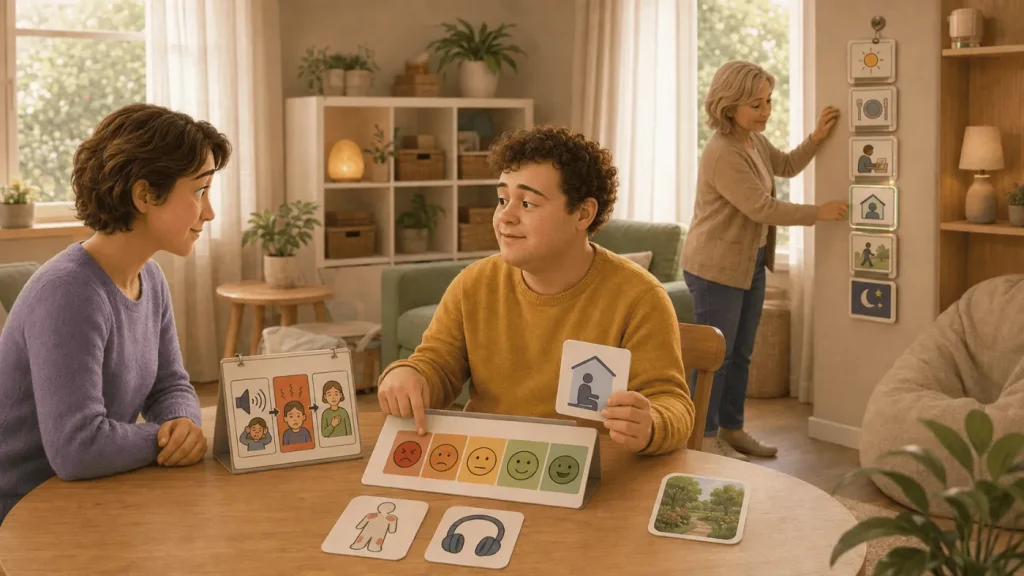
Replacing ”How do you feel?” with a question they can answer might be the right shift. This broad question can seem too abstract, particularly when the person is tired, anxious, or struggling to process language. You can offer a simpler way to respond and give the person the choice to use their preferred communication. The person might:
- choose a colour;
- point to a picture;
- select a number from one to five;
- use a familiar gesture;
- type or write their answer;
- identify a bodily sensation; or
- choose between ”comfortable”, ”not sure”, and ”need help”
Check-ins work best when they are brief, predictable and free from pressure. Try them at natural points in the day, such as after school, before an outing or at bedtime. Accept “I don’t know” as a valid answer. Over time, families can gently explore patterns: “You chose orange after the room became noisy. Would headphones or some quiet time help?” This turns a check-in into a bridge between the person’s internal experience and practical support.
Use Predictable Routines
Predictability can give the nervous system fewer uncertainties to manage. A familiar routine helps the person understand what is happening now, what will happen next and when they will have an opportunity to rest. This might include:
- a visual timetable
- a simple ”now and next” board
- consistent morning or bedtime routines
- countdowns before transitions
- advance notice of visitors or appointments
- planned breaks following demanding activities
What is preferably recommended to maintain predictability? – Familiar routines, communicating changes as early as possible, and introducing manageable changes gradually in safe, familiar settings.
Lived-experience discussions also reinforce the value of this approach. In one National Autistic Society community conversation, an autistic parent explained that knowing more about the day ahead increased the likelihood of a successful transition, while fewer repeated reminders reduced pressure.
Teach Emotion Labels
Teaching emotion labels is rarely about testing whether someone can correctly name a facial expression, but helping them connect an experience, a bodily signal and a word or another meaningful form of communication. Start with emotions that arise naturally:
- ”Your hands are covering your ears. It might be too loud.”
- ”Your body looks tense. I wonder whether you feel worried.”
- ”You are smiling and moving quickly. You look excited.”
- You moved away when I asked. Do you need a break?”
Emotion cards, body maps, drawings, photographs, comic-strip conversations and personalised scales can make difficult emotions more concrete. Practise when the person is comfortable, not when in the middle of a crisis, when language and reflection may be least accessible.
Plan Ahead for Difficult Moments
When someone is overwhelmed, it is rarely the best time to ask them to explain what they need or learn a new regulation technique. Planning ahead allows the person and family to agree on support while everyone is calm.
A simple emotional regulation plan can identify:
- situations that commonly create distress;
- individual early warning signs;
- how the person communicates “stop”, “no” or “I need help”;
- where they would like to go;
- whom they want nearby;
- what usually helps;
- what makes the situation worse;
- what other family members should do; and
- how much recovery time they may need afterwards.
Prepare practical supports in advance, such as a communication card, headphones, a favourite item, a drink or a small regulation kit, but make sure the person can choose whether to use them. No strategy works for everyone or on every occasion.
Using Positive Behaviour Support (PBS) to Promote Emotional Regulation
Emotional regulation is rarely achieved by asking someone to “calm down”. From a Positive Behaviour Support (PBS) perspective, it develops when we understand what is making regulation difficult and change the support around the person accordingly.
A PBS specialist looks beyond the emotional reaction itself. Distress may be communicating pain, sensory overload, anxiety, uncertainty, an unmet need or difficulty making oneself understood. Functional assessment helps the team explore what happens before, during and after these moments, alongside the person’s communication, sensory profile, health, relationships, routines and experiences of trauma. The purpose is not to control behaviour, but to understand what the person may be communicating and create a more capable environment in which they experience greater safety, choice and quality of life. Support can then become proactive. This may involve making routines more predictable, adapting sensory demands, using accessible communication, increasing meaningful choice and recognising the person’s earliest signs of distress.
When the person feels safe, and their nervous system is more settled, the team can help them develop personalised emotional regulation skills. These might include requesting a break, communicating pain, labelling their own emotions, using a visual feelings scale or choosing between familiar emotion regulation techniques. Strategies should be co-produced, accessible and practised during calm moments, not introduced for the first time during a crisis.
As Ben Andrew, our PBS Coach and Multimedia Specialist, explains:
“A PBS plan is just a piece of paper until it’s brought to life through practice leadership.”
Read more about Why Behaviour Support Starts with Listening.
Responding Calmly During Emotional Distress
Calm is not something we can demand from another person, but something we can help create around them. Emotional dysregulation may indicate that the person’s ability to cope has been exceeded. When someone is overwhelmed by distress or unpleasant emotions, they may temporarily find it harder to process language, make decisions or use their usual emotional regulation skills. During these moments, families and carers should focus on safety and co-regulation. Use a calm voice, reduce the number of words and allow additional processing time. Where possible, lower demands, reduce noise or lighting and offer familiar support, such as movement, music, sensory items or access to a quiet space. Avoid unexpected touch unless the person has shown that it helps. The immediate aim is not to reason with the person or require them to self-regulate, but to reduce pressure and help them regain a sense of safety when they have difficulty managing their own emotions.
Once the person has recovered, families can gently explore what may have contributed to the distress and what helped. Practising strategies during calm periods can build self-awareness, distress tolerance, and self-regulation, supporting the person in communicating their needs and managing stressful situations more confidently. Improving emotional regulation takes time, consistency and trusting relationships. Self-compassion matters for carers too: remaining calm in difficult moments is not always easy. A personalised PBS plan can help everyone recognise early signs of distress, respond consistently and protect the person’s long-term wellbeing.
Complex Needs Support with Unique Community Services
At Unique Community Services, our in-house therapy team brings together Positive Behaviour Support (PBS) specialists and PROACT-SCIPr-UK® experts to understand what may be contributing to distress.
If you want to learn more about our work and outcomes for the people we serve, please download our 2025 Outcomes Report for free.
Through assessment, observation, and close collaboration with the person, family members, and those who know them best, the team identifies potential triggers, early signs of distress, communication preferences, and sensory needs. This understanding informs practical support such as environmental adaptations, structured routines, Talking Mats, building capable environments, mindfulness techniques and strategies for communicating emotions or requesting a break. Multimedia can make these strategies more accessible and meaningful:
“We use multimedia to co-produce PBS plans with the individual, create video-based social stories, and facilitate post-incident reflection through video debriefs.” – Ben Andrew, PBS Coach and Multimedia Specialist.
The purpose is not to suppress emotional responses. It is to help the person feel safer, communicate more effectively and develop skills that support greater emotional regulation, confidence and independence.
Whether you need complex care, are seeking reliable care partnerships, are planning a new transition, or are exploring bespoke support options, our team is here to provide help.
Offices: Manchester and Leeds
Redefining what complex care should feel like – compassionate, connected and genuinely unique. – Unique Community Services
