
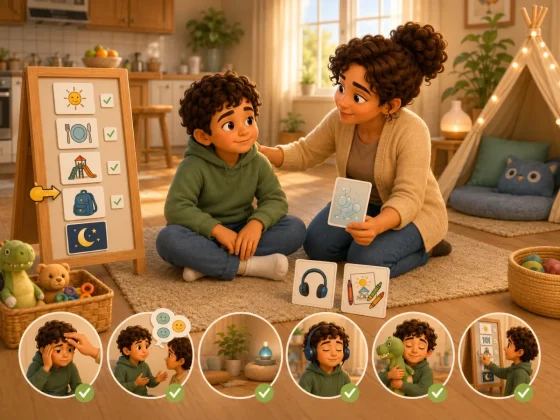
What Does It Mean to Listen in Behaviour Support?
Communication goes far beyond spoken words. So does positive behavioural support. It means recognising every way a person expresses themselves, whether through speech, signs, gestures, facial expressions, and movement, or through withdrawal, changes in routine, assistive communication aids, and changes in behaviour. For someone who cannot easily describe pain, fear, sensory overload or an unmet need, behaviour may be their most effective way of saying, “Something is wrong,” “I need space,” “I do not understand,” or “This is too much.”

Listening in positive behaviour support also means slowing down and communicating on the person’s terms. A person may need fewer words, longer processing time, visual information, Talking Mats, objects of reference, familiar supporters or another form of augmentative and alternative communication. They may communicate differently when overwhelmed, unwell or in an unfamiliar environment.
Most importantly, listening must lead to action towards positive behaviour. It is not enough to record that noise causes distress, that the person needs more time, or that a behaviour may communicate pain. Behaviour support must change: the environment may need adapting and turning into capable environments, demands may need reducing, a health concern may require investigation, communication tools may need introducing, or the person may need greater choice and access to meaningful activities. Within positive behavioural support, listening is how services move from managing behaviour to understanding the person and from asking for compliance to creating a life in which the person has less need to communicate through crisis.
Looking Beyond Diagnoses and Behaviours
Listening in behaviour support means refusing to reduce a person to a diagnosis, risk profile or behaviour label. Autism, learning disability and mental health diagnoses may help explain certain needs in children, young people and adults. Still, they do not tell us who the person is, what they value or why they are distressed in a particular moment. As people in care, we should never forget the importance of treating each person as a unique individual and understanding their specific strengths, abilities, communication needs and wider life circumstances.
Looking beyond diagnoses and behaviours allows care teams to see distress not as a personal failure, but as information about what the person and their environment may need. It also means asking what may be happening to the person, rather than assuming the problem exists solely within them. A person-centred approach therefore asks:
Who is this person beyond the behaviour? What matters to them? What has happened in their life? What are they trying to communicate, avoid, access or change?
All Behaviour is Communication
A person feels truly heard when staff recognise that behaviour communicates something, and when that recognition leads to meaningful changes in their support, environment and quality of life. The Iceberg Model encourages us to look beneath the behaviour. PBS helps us understand what we find there and act on it.
The Iceberg Model of Behaviour
The Iceberg Model helps care teams understand that the behaviour they can see is only the small, visible part of a much larger experience. Like the small section of an iceberg above the water, visible behaviour may include shouting, withdrawing, refusing, self-injury, aggression, breaking objects, repeated questioning or trying to leave. Beneath the surface may be pain, fear, sensory overload, trauma, anxiety, communication barriers, uncertainty, loneliness, unmet needs, loss of control or an environment that does not feel safe.
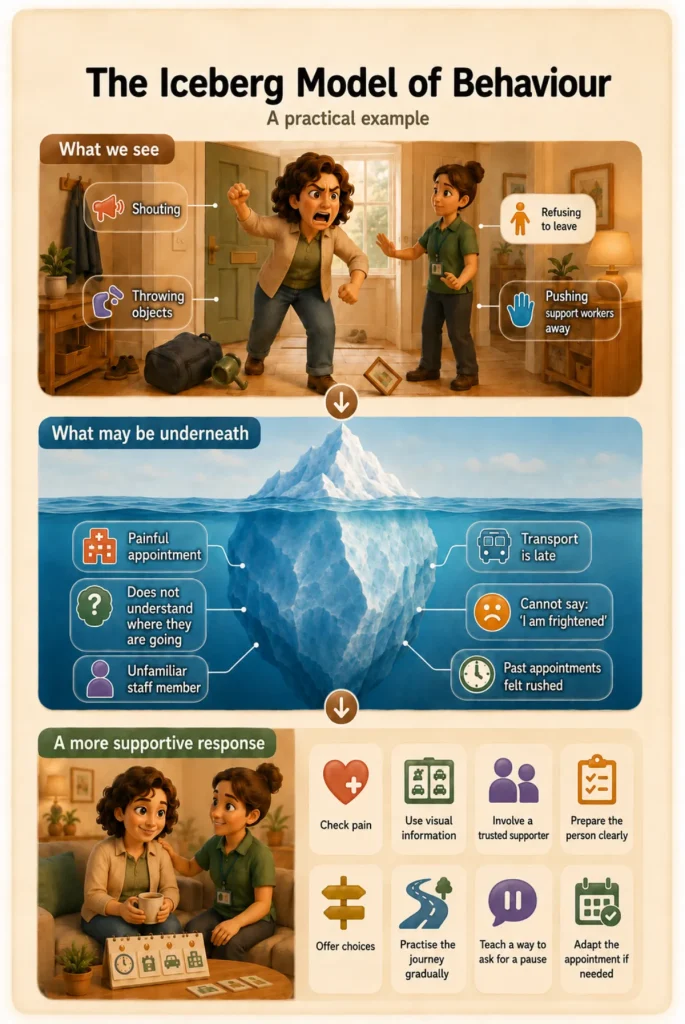
The model encourages teams to treat behaviour and behaviour support as information. Listening may involve spoken language, but it can also mean noticing facial expressions, movement, withdrawal, changes in sleep, use of communication aids and patterns across different situations.
For people who communicate without speech, listening may require:
- pictures or symbols;
- Talking Mats;
- objects of reference;
- signing;
- communication devices;
- video or multimedia support;
- sufficient processing time;
- involvement from people who understand the person’s communication well.
The deepest value of the Iceberg Model is that it changes how we see the person. A visible behaviour may be the final part of a much longer experience: hours of sensory pressure, days of uncertainty, untreated pain, repeated misunderstandings or years of not being listened to. The model invites care teams to pause before describing the person as challenging and ask, “What might this person be carrying beneath the surface, and what are they asking us to understand?“
Positive Behaviour Support (PBS)
Positive Behaviour Support turns this curiosity into a structured, person-centred process. Our PBS practicioners use positive behavioural support to assess what behaviour may mean for the person, what happens before and after it, and what the person may be trying to access, avoid, change or communicate. It then uses that understanding to adapt the environment, improve communication and develop alternative skills that meet the same need more safely.
Always done with the person, not to them, with meaningful involvement from the person, their family and those who support them. Our specialists use these proactive approaches, including personalised activities, environmental adaptations, improved communication and skills that enable the person to achieve the same purpose without needing to reach crisis, to strengthen and humanise the behaviour support they provide.
The Importance of Active Listening
As we have already mentioned, active listening in positive behavioural support is never limited to spoken words. Still, it is very much in tune with learning how a person communicates, noticing what matters to them and allowing what we learn to change the support being delivered. For children, young people and adults receiving complex care (https://uniquecs.co.uk/home-care-services/complex-care/), listening should shape everyday practice, staff training, behaviour support strategies and the continued development of more person-centred, capable environments.
Understanding Personal Preferences
Personal preferences reveal what helps a person feel safe, comfortable, motivated and understood. This includes preferred routines, foods, activities, sensory environments, relationships, and ways of receiving support. For someone with a learning disability, autism or limited spoken communication, preferences may be expressed through body language, approach and avoidance, emotional responses, behaviour or repeated choices.
A person may prefer fewer words, longer processing time, a particular support worker, a quieter environment or a different order of activities. In positive behaviour support, understanding preferences can also support positive behaviour. When people have access to meaningful activities, familiar routines and genuine choices, positive reinforcement strengthens useful skills, encourages desired behaviours and increases motivation. Personalised daily activities, environmental adaptations and alternative skills are proactive approaches for supporting people whose behaviour signals distress and are the primary foundation for living a more fulfilled life.
Involving People in Their Own Support
Active listening in behaviour support also means involving people in the decisions that affect their lives. The person should be supported to express what they want, what they dislike, what makes them feel safe and how they want others to respond when they become distressed. Meaningful involvement may require visual tools, symbols, objects, videos, Talking Mats, observation or support from people who understand the person’s communication well. A lack of speech should never be mistaken for a lack of views.
Our practitioners get to know what the person wants from life and actively involve them in decisions. Creative methods for involving people with a learning disability, autism and complex communication needs in the development of plans that reflect their experiences, preferences and aspirations can help ensure their voices meaningfully shape the support they receive.
Here, we share daily activities for adults with a learning disability that you can try with your loved one.
Learning from Previous Experiences
Previous experiences may explain why a person finds certain places, people, demands or forms of support difficult. They may have experienced trauma, repeated placement breakdowns, multiple unsuccessful hospital discharges, inconsistent care, restraint, exclusion, painful procedures or communication that was repeatedly ignored.
Learning from experience should become part of ongoing PBS practice. Incident records, family insight, the person’s responses and direct observation can inform support plans, staff training and risk management. It is the care team’s responsibility to explore which approaches have helped, which have increased distress and what the person’s behaviour may have communicated in earlier situations. This prevents ineffective or harmful responses from being repeated. It also allows support teams to build on successful routines, trusted relationships and coping strategies instead of beginning again whenever a service or staff member changes.
How to “Listen” When an Individual is Non-Verbal or Minimally Verbal
For a non-verbal or minimally verbal person, communication may appear in the smallest physical changes such as faster breathing, tightened muscles, widened pupils, turning away, becoming unusually still or moving towards a trusted person. A sudden loss of appetite, disrupted sleep or refusal to enter a particular room may be highly articulate ways of saying, “Something feels wrong,” “I do not feel safe,” or “I need you to notice this.”
Families and support workers can listen more carefully by:
- Learning the person’s usual baseline and noticing what changes
- Recording patterns without rushing to interpret them
- Considering pain, illness, sensory discomfort or recent events
- Comparing observations with people who know the person well
- Offering simple choices and allowing extra processing time
- Using visual, signed or multmedia communication where helpful
- Treating behaviour as information rather than defiance
🗣 The goal of positive behaviour support is not to make the person communicate differently, but to become better at recognising the language they already use.
The Benefits of Listening-First Behaviour Support
Listening-first behaviour support begins with understanding what the person may be communicating through their words, actions, body language, routines and responses to the environment. Rather than reacting only to what is visible, support teams explore what may be contributing to distress and use that understanding to shape more personalised, proactive care. Active listening in positive behavioural support leads to fewer incidents, less reliance on restrictive practices and improved emotional wellbeing.
Fewer Behavioural Incidents
When people feel heard, their needs are more likely to be recognised before distress escalates. Listening can help teams identify pain, communication difficulties, sensory overload, anxiety, changes in routine, unmet preferences or environmental factors that may be contributing to behaviours of concern.
Support can then be adapted through clearer communication, meaningful choices, more predictable routines, preferred activities and earlier responses to signs of distress. Over time, this can reduce the frequency, intensity and duration of behavioural incidents because the person no longer needs to rely as heavily on behaviour to show that something is wrong.

Reduced Need for Restrictive Practices
Listening-first support helps care teams move away from crisis-led responses and towards prevention. Our practitioners prioritise proactive approaches designed to understand potential triggers, adapt the environment, strengthen communication, build everyday skills and provide the right support before distress reaches crisis.
If a person has experienced restraint or another restrictive intervention, the first question is whether every proactive option was fully explored before a reactive strategy was used. Where immediate risk means intervention cannot be avoided, our teams always work towards the least restrictive response available, used only for the shortest necessary time. Each incident should then inform future learning, with support plans reviewed to reduce the likelihood that restraint will be needed again.
Improved Emotional Wellbeing
Being listened to can help a person feel safer, respected and more in control. This is particularly important for people who have experienced repeated misunderstandings, placement breakdowns, trauma or restrictive care. When staff take communication seriously and respond consistently, the person can begin to build trust in the people supporting them.
Listening-first support can also increase access to meaningful relationships, preferred routines, community activities and choices about everyday life. These changes do more than reduce behaviours of concern; they support confidence, emotional security, belonging and a stronger overall quality of life.
Listening as a Bedrock of Ethical Care
Listening is where ethical care begins. It is the decision to see a person not as a diagnosis, a risk or a behaviour to be managed, but as someone with a voice, a history and a right to shape their own life. Sometimes that voice is spoken. Sometimes it appears through a pause, a refusal, a change in routine or a moment of distress. To listen well is to notice all of it and to let what we hear change the support we provide.
Ethical care requires teams to manage risk without unnecessarily limiting the person’s life. Environmental adaptations may replace a locked door, increased staffing may be reduced through better training, refusal may be addressed through clearer communication, and crisis responses may be prevented by recognising early signs of distress. A person has not been truly listened to if their communication is acknowledged but nothing changes. Ethical listening should influence:
- the person’s support plan
- how staff communicate
- the demands placed on them
- their routines and environment
- health investigations
- access to preferred activities and relationships
- crisis and recovery strategies
- decisions about restrictions
At its heart, ethical care asks: Are we supporting this person to exercise their rights and live the life that matters to them, or are we asking them to fit into the support that is easiest for us to deliver?
Positive Behavioural Support with Unique Community Services
At Unique Community Services, through positive behaviour support, we work alongside families and care teams to understand what may be contributing to distress, build trust, and create proactive support around the person’s communication, interests, routines, and goals.
Positive outcomes with UCS can look like:
- fewer and less frequent behaviours of concern
- safer, more confident access to the community
- personalised routines built around interests and communication needs
- positive risk-taking that opens new opportunities
- greater consistency from trained and well-matched support workers
- improved emotional wellbeing, confidence and enjoyment
- family holidays and shared experiences becoming possible again
- greater reassurance and meaningful respite for relatives
- more independence, belonging and freedom to live life on the person’s own terms
For William, this meant moving beyond managing risk and creating new opportunities to travel, take part in community life and enjoy meaningful experiences with his family.
“This year, William’s experienced only a few minor behaviours of concern which were handled as professionally as we’ve come to expect. He’s happy, and so are we.” – William’s parents.
How Specialist PBS Training Helps Keep Your Loved One Safe and Well
Our PBS specialists receive comprehensive training in Positive Behavioural Support and PROACT-SCIPr-UK®. Unique Community Services follows clear training standards designed to support safe, consistent and high-quality PBS practice. Training is reinforced through ongoing coaching, observation and review, helping teams maintain quality, apply proactive strategies confidently and continue developing their practice around each person’s needs.
“The team that works with us and William are a credit to the company. We feel blessed that they are now part of our family’s lives. Saying thank you just doesn’t seem enough. My wife and I have started going out again and living a regular life. My 21-year-old daughter and her boyfriend are managing to go out in the evenings, which hasn’t been possible until now.” – William’s father.
Looking for personalised Positive Behavioural Support for someone you care about? Make a referral today, and let’s create a safer, more meaningful and more independent life.
Offices in Manchester and Leeds.
