

How Does Unsuitable Housing Lead to Readmission?
There are several pathways through which unsuitable housing can disrupt and undermine recovery. These include exposure to health hazards, difficulty managing daily activities, sensory distress, housing insecurity, and an environment in which the agreed support cannot work effectively. So, let’s discuss how the home environment can directly undermine recovery when housing problems are:
- Stairs, inaccessible bathrooms, unsafe flooring or inadequate space – Everyday movement, toileting and personal care can become difficult or hazardous, particularly where mobility has changed.
- Damp and mould – Exposure can cause or worsen respiratory illness and affect mental wellbeing.
- A cold or unaffordable-to-heat home – The person may be unable to maintain the warmth needed to protect their health.
- An overwhelming sensory environment – Noise, lighting, smells or lack of personal space can contribute to distress and make engagement with support harder.
- Unstable accommodation or homelessness – Recovery competes with finding somewhere to stay, and access to continuing healthcare may be disrupted.
A study compared 2,772 people experiencing homelessness with the same number of people with housing, following emergency admissions across 78 hospitals. Within a year of leaving hospital:
- 61% of people experiencing homelessness had an emergency readmission — around 6 in every 10.
- 33% of people with housing had an emergency readmission — around 3 in every 10.
Differences in people’s health have been considered, and even after doing this, the emergency readmission rate was about two and a half times higher among people experiencing homelessness. That figure counts repeat readmissions, so it measures something different from the percentage of people returning at least once. The main message is that recovery depends on someone’s living situation as well as their medical treatment. Having somewhere stable to live can make it easier to rest, manage daily needs and access ongoing care.

What Does “Suitable Housing” Mean After Hospital Discharge?
Suitable housing holds greater meaning when included early in the discharge process. When the right housing is involved from day one, with the right community teams and hospital staff, therapy team, care coordinators, housing providers, commissioners, local authorities, and advocates, returning home becomes reality. Suitable housing should question whether the home provides physical accessibility, is warm, ventilated, and free from significant hazards, whether there are environmental or interpersonal reminders of previous trauma, whether the person wants to live alone, with family or other people, or whether the shared arrangement is compatible with their personality and needs, etc. Suitability is individually related to the person and should be part of the assessment process, the care plan, treatment plan, and service delivery.
Trauma-Informed & Sensory-Aligned Spaces
Trauma-informed care is defined around six principles, including safety, trust, collaboration, empowerment, and cultural consideration. Through this type of care, trauma-informed specialists tend to prevent re-traumatisation and improve people’s lives by providing care that supports their nervous system.
Applied to housing after discharge, these principles suggest exploring:
- What the person needs to feel physically and emotionally safe.
- Privacy, personal boundaries, and how staff enter the person’s space.
- Choice over furnishings, routines, and involvement in decisions, where possible.
- Predictable explanations of visits, changes and support management.
- Whether features of the environment evoke distressing memories.
- How important it is to preserve relationships, cultural identity, and familiar possessions.
The above-mentioned bullets are practical applications of the principles. A property can look comfortable to professionals but feel unsafe to the person who will live there. Speaking of sensory-aligned spaces, they are central to autistic wellbeing at home. They emphasise personal space, possessions, interests, shared environments, and the involvement of autistic people in assessing their surroundings. Support plans should always consider:
- Sound (traffic, neighbours, communal corridors, appliances and sound travelling between rooms)
- Light (brightness, glare, flicker and control over daylight)
- Smell (cooking, cleaning products and ventilation)
- Touch (bedding, furniture and surfaces the person regularly uses)
- Space (somewhere to withdraw, decompress or pursue interests)
- Control (opportunities to adjust the environment to personal preferences)
Aligning the environment with the person’s specific sensory profile should remain the priority in every decision about the person’s home development and present or future adaptations. Since every person has different sensory needs, some people may need reduced stimulation. Therefore, changes should be informed by the person’s responses and preferences.
How Housing, Health, and Social Care Must Align
A suitable property needs a support arrangement that matches it, because housing decisions and care decisions should inform each other. A practical division of responsibilities is:
| Partner | Contribution to a coordinated plan |
|---|---|
| Hospital and community health teams | Identify ongoing treatment, rehabilitation and clinical support needs. |
| Occupational therapists | Assess how the person can function in the home and what equipment or adaptations may help. |
| Social care teams and commissioners | Assess support needs and arrange a sustainable care package. |
| Housing teams and providers | Identify accommodation, assess property feasibility, arrange repairs or adaptations, and support tenancy arrangements. |
| PBS and other specialist practitioners | Contribute understanding of communication, distress, routines and environmental needs. |
| The person and their chosen supporters | Define preferences, priorities and what makes a home workable and meaningful. |
At a strategic level, councils must understand supply, unmet need and future demand through partnership working.
Why Housing Should Be Considered Early?
Housing should be considered early in hospital discharge planning because finding or adapting a suitable home takes time. Identifying housing needs from admission gives health, social care and housing teams time to assess accessibility, sensory needs, safety and the person’s preferences, arrange adaptations and coordinate ongoing care. An early assessment determines how complex the situation is and creates time to explore adaptations, obtain approvals, identify alternative homes and coordinate support.
For autistic people, people with learning disabilities and people with complex care needs, early planning helps ensure the home supports daily living, emotional wellbeing and independence. Involving the person, their family or advocates from the beginning allows their needs and choices to shape housing decisions. This helps prevent avoidable discharge delays and prepares the right environment and support for a sustainable transition from hospital to home.
The Role of Positive Behaviour Support
Positive Behaviour Support (PBS) helps identify what a person needs in their home and support environment to experience a better quality of life.
QUOTE: The core principles of Positive Behaviour Support remain the same across groups: understanding the function of behaviour, improving quality of life, teaching skills, adapting environments and reducing reliance on restrictive practices. What changes is how the assessment and support are delivered. – Darren Moyle, PBS Practitioner at Unique Community Services.
Positive Behaviour Support can be used in a family home, a supported-living service, a hospital or a secure setting. Yet when a plan is transferred unchanged between people or environments, can it still be considered person-centred? The strength of PBS lies in maintaining a consistent set of values while tailoring assessments, communication, expectations and environments to the individual. This is particularly important for people with complex needs, where several interconnected factors may shape their experiences, beyond any single diagnosis or behaviour.
By creating a tailored PBS approach, PBS practitioners simultaneously build capable environments that meet people’s needs, create positive interactions, and allow people to do the things that matter to them. For discharge planning, building capable environments means considering the building, relationships and daily opportunities together. A practical example would be that the team should review whether strategies developed in hospital will work in the new home. Different noise, people, routines and expectations may change the person’s experience. When care teams provide eligible care, the quality standard on personalised daily activities reinforces proactive strategies that improve quality of life and remove conditions associated with behaviours of concern.
When the Existing Home Cannot Be Made Suitable?
An existing home may be unsuitable for hospital discharge when adaptations cannot adequately meet the person’s physical, sensory, emotional or care needs. The reasons contributing to this outcome can be:
- Insufficient space that cannot be altered to accommodate equipment or safe assistance.
- Persistent noise or shared spaces with others whose needs or routines are incompatible with the person’s wellbeing
- Serious property hazards
- A layout or location that prevents essential care and support from being delivered reliably
- Housing insecurity
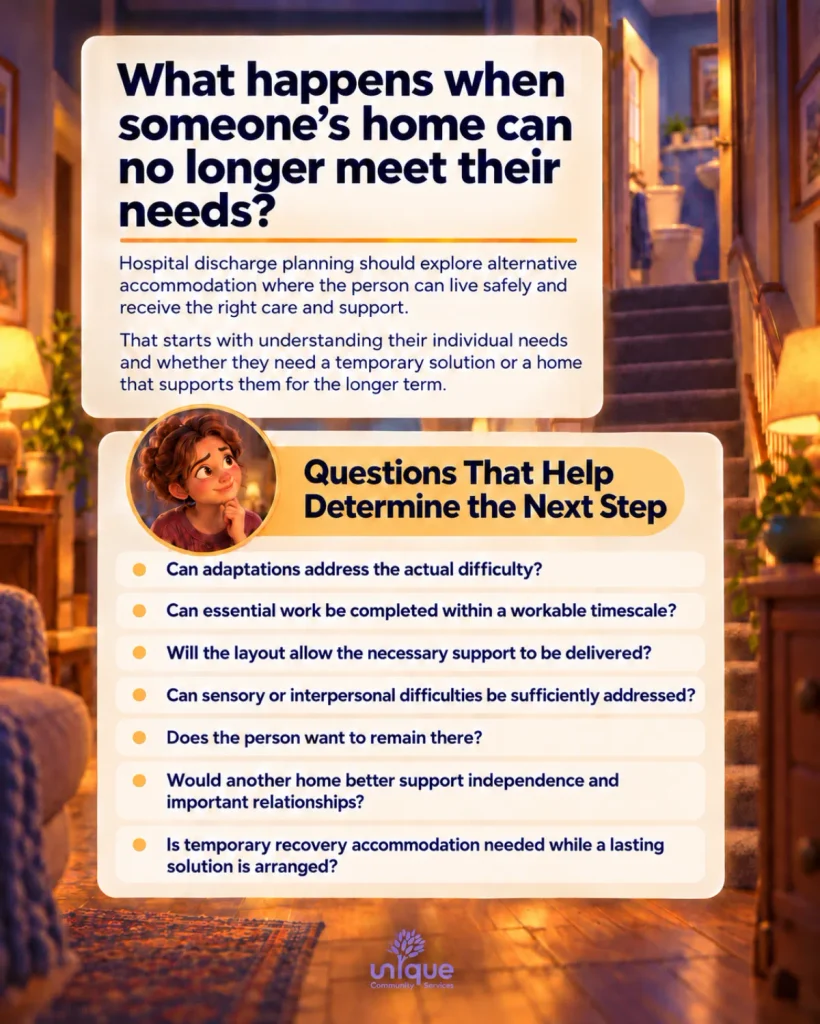
When an existing home cannot be adapted to meet a person’s needs, hospital discharge planning should identify alternative accommodation where they can live safely and receive the right care and support. The next step should be an individual assessment of alternatives, including whether the problem is temporary or enduring.
Hospital Discharge and Homelessness
People experiencing homelessness or at risk of homelessness require early, coordinated support to leave hospital safely and continue their recovery. For the person to be discharged safely, planning should include a housing strategy from day one and identify a suitable property where they can feel at home. In England, specified NHS services have a duty to refer people they believe may be homeless or threatened with homelessness to a local housing authority, with the person’s consent. This should happen early enough to explore housing options and arrange support. But a referral alone does not secure accommodation or complete the discharge plan.
Safe hospital discharge requires accommodation where the person’s recovery needs can be met. Depending on their circumstances, this may involve housing with support, specialist intermediate care or temporary step-down accommodation. Hospital discharge and community support guidance (see section 9) states that people should not be denied intermediate care because they are experiencing homelessness. It also recommends a welfare check on the day of discharge and help settling into accommodation. Housing, health, social care and ongoing support need to be coordinated so the person can receive treatment, recover and work towards a more stable living situation.
Read more about care after hospital discharge and what families need to know.
Who Should Be Involved in Housing, Care Plan, and Discharge Planning?
Housing and hospital discharge planning should involve the person, their chosen supporters, hospital staff, community health professionals, social workers, housing teams and the provider delivering ongoing care. Families, unpaid carers and independent advocates should be involved where appropriate, respecting the person’s wishes and consent. Depending on individual needs, the team may also include occupational therapists, rehabilitation professionals, mental health services and voluntary organisations. Discharge teams and care transfer teams bring these services together to coordinate accommodation, treatment and support.
Each partner contributes a different part of the assessment, and together they inform a shared plan with clear responsibilities and arrangements for reviewing support after discharge.
Read more about how families can work with specialist teams to improve care.
The Role of a Complex Care Provider
A complex care provider helps translate the discharge plan into practical, personalised support in the person’s home or community setting. Involving the provider early allows the team to establish whether the proposed accommodation can support care delivery, identify staffing and training requirements, and prepare for the person’s immediate needs. Ongoing care providers need to be included early so eligible support can be prepared before discharge.
After discharge, the provider’s role is to deliver the agreed support, help the person establish daily routines and recognise changes that require professional review. They continue to maintain communication with community professionals and raise concerns when the care plan or environment no longer meets the person’s needs. The continuing coordination supports recovery and helps the team respond to emerging difficulties before they escalate.
How Can Unique Community Services Help?
We provide long-term support to people of all ages who require complex care, living with a learning disability, autism, physical disabilities, even those with multiple diagnoses – most complex cases.
Recently, we began a partnership with CHD Housing to create the right housing solutions to help people find their own home. Working together, our goal is to help reduce unnecessary hospital admissions, delayed discharges, placement breakdowns, and out-of-area placements.
In partnership with CHD Housing, we provide bespoke supported living properties throughout Manchester, Leeds, and the North of England, with plans to develop new accommodations in areas of need across the UK. Each property provides a high-quality supported living environment for people with learning disabilities, autism, and complex needs. The property is being developed to create a safe, welcoming, and adaptable home environment that promotes independence while ensuring people receive the specialist support they need through our services.
Through a personalised referral and admissions process, we ensure you find the right support to meet the unique needs of the people we serve.
Our offices: Manchester and Leeds
