
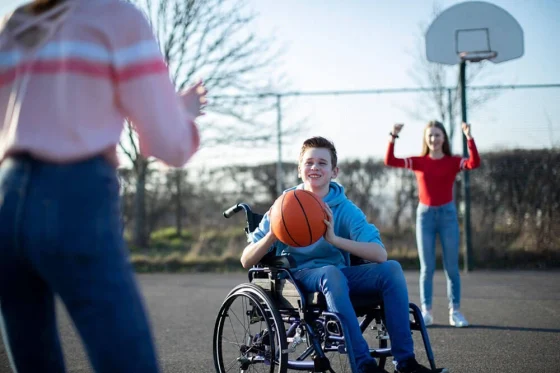
What Is Physical Disability Inclusion?
Disability inclusion is the practice of ensuring that people with disabilities, including those with physical disabilities, can participate fully and equally in all aspects of society (education, work, community life, healthcare, social activities, etc.). Inclusion goes beyond physical access, and it involves removing attitudinal, social, institutional, and communication barriers so people are truly included and valued on an equal basis.
Inclusion means people are respected, involved in decisions that affect them, and have equal access to opportunities and services, free from discrimination. The approach is built on human rights principles, notably the Equality Act 2010, which legally protects disabled people from discrimination and requires “reasonable adjustments” to remove barriers in access, employment, and services.
To read more about it, download our free overview of the Equality Act 2010.
Why Is Physical Disability Inclusion Important?
Inclusion ensures disabled people are recognised as equal citizens with the right to education, work, participation in community life, and access to public services, rather than being treated as passive recipients of care or charity.
Inclusion ensures:
- Equal access to opportunities
- Protection from discrimination
- Fair treatment in work and services
The UK is also a signatory to the United Nations Convention on the Rights of Persons with Disabilities (UNCRPD), which reinforces the right to full participation in society.
Organisations must make reasonable adjustments to remove barriers in employment, education, housing, transport and public services. Ensuring equal access, opportunities, and inclusive environments for people with physical disabilities can lead to a range of positive outcomes, including:
- Removal of barriers to transportation and housing, creating a more accessible and inclusive society
- Reduced health risks for individuals through improved access to healthcare and support services
- Increased educational opportunities, allowing individuals to develop their skills and reach their full potential
- A more diverse and inclusive workforce that benefits from the unique perspectives and talents of individuals with disabilities
- Expanded employment opportunities, enabling individuals with disabilities to contribute to the workforce and achieve economic independence
- Social inclusion, fostering a sense of belonging and community for individuals

Data from the Office of National Statistics consistently shows that disabled people in the UK experience lower employment rates, higher poverty levels, increased risk of social isolation, and barriers in accessing services.
Barriers Faced by People with Physical Disabilities
In the UK, many of the barriers faced by people with physical disabilities are not caused by their impairment itself, but by environments, systems and attitudes that have not been designed inclusively. The social model of disability, widely promoted by organisations such as Disability Rights UK, explains that people are disabled by barriers in society rather than by their bodies alone. Understanding these barriers is the first step toward meaningful inclusion.
There are physical, environmental, attitudinal, employment, economic, digital and systemic barriers, followed by housing and transport limitations. The most visible barriers are found in the built environment. Inaccessible buildings, steps without ramps, broken lifts in train stations, narrow doorways, and limited accessible toilets can all restrict independence. Over time, this affects well-being, confidence and quality of life.
Physical Disability Inclusion in the Workplace
Physical disability inclusion in the workplace means creating environments where people with physical impairments can access, participate, progress and lead on an equal basis with others. This commitment is particularly important across sectors such as health systems, where inclusive practice directly influences workforce sustainability and quality of care. Creating an inclusive workplace for individuals with physical disabilities means going beyond mere representation and actively valuing the unique contributions of people with physical disabilities. Inclusivity, in the context of physical disability, means providing equal opportunities for all employees to thrive and grow in their roles, including new employees entering the organisation. It requires organisations to make necessary accommodations to ensure that employees with physical disabilities can access their workspaces and perform their tasks efficiently, and to invest in appropriate disability training to strengthen awareness and capability across teams.
Furthermore, inclusivity means fostering a culture that appreciates and celebrates the strengths and perspectives of individuals with physical disabilities and developmental disabilities. Companies should actively involve them in decision-making processes, as they bring unique insights and innovative problem-solving approaches. Promoting inclusion of people with physical disabilities can positively impact an organisation’s reputation and brand loyalty. Customers and clients increasingly appreciate and support businesses that prioritise diversity and inclusivity and that actively employ people from diverse backgrounds and abilities.
Physical Disability Inclusion in Schools
Disability inclusion in schools means ensuring that all children and students have the support they need to learn, contribute and participate fully in school life. Inclusive education is reflected in how classrooms, programmes and activities are designed, with accessibility and participation in mind from the outset. A key part of this approach is carefully assessing the individual needs of children and students with disabilities to identify appropriate accommodations and support. This enables a tailored response that recognises each child’s unique strengths and requirements. Schools can then provide personalised adjustments, such as specialised furniture, adapted writing or communication tools, and assistive technology, to remove barriers to learning and participation.
Ongoing monitoring and evaluation are equally important to ensure these adjustments remain effective and responsive to changing needs. Inclusion also extends beyond the classroom: students with physical disabilities must have equal access to all learning opportunities, including extracurricular and after-school activities, so they can fully engage in the wider school community. At its core, disability inclusion recognises that every child has the right to a high-quality education in an environment where they can explore their interests, develop their talents and achieve positive outcomes.
Physical Disability Inclusion in Sport
Disability inclusion in sports means ensuring equal participation of people with physical disabilities in sporting activities. Participating in sports helps people develop social skills, including communication, teamwork, and cooperation. Engaging in team sports or group activities fosters interactions with others, promoting social integration and the development of important interpersonal skills. By participating in physical activities and overcoming challenges, individuals build autonomy and self-reliance. Sports provide opportunities for people to push their limits, build confidence, and learn to navigate obstacles, ultimately enhancing their overall independence.
Regular physical activity helps individuals with disabilities improve their physical fitness, coordination, and motor skills. This contributes to their overall well-being and can positively affect their mental health, promoting a sense of accomplishment and improved self-esteem. Lastly, sports empower individuals with physical disabilities to build self-sufficiency. This sense of empowerment extends beyond sports and can positively impact various aspects of their lives, fostering greater independence and resilience. Beyond recent developments, there remains a need to improve policies and regulations, adjust materials in traditional sports, and adapt sports facilities.
Benefits of Sport for People with Physical Disabilities
The greatest benefits sport offers people with physical disabilities are physical, psychological, and social. In the UK, organisations such as Sport England emphasise that disabled people are less likely to be active, often due to environmental and attitudinal barriers rather than a lack of interest. When inclusive opportunities are available, participation supports overall health, independence and confidence. Sport is not only recognised as exercise but also as a pathway to equality and belonging.
Physically, adapted sport improves strength, mobility, and cardiovascular health while helping prevent secondary conditions linked to inactivity. Regular physical activity is essential for long-term well-being, including for people with long-term physical conditions. Beyond physical health, sport contributes significantly to emotional resilience and social connection.
Key benefits include:
- Improved muscle strength, balance and endurance
- Improved mental health (reduced stress, anxiety and low mood)
- Increased self-esteem and sense of achievement
- Opportunities for teamwork and friendship
- Development of discipline, goal-setting and leadership skills
Inclusive sport also challenges stereotypes and increases the visibility of disabled athletes, particularly through global platforms such as the Paralympic Games. By removing barriers to participation, communities improve individual well-being and promote broader disability inclusion. Sport shifts the focus from limitation to capability, reinforcing that access to movement, competition, and community should be available to everyone.
Physical Disability in the Community
Achieving inclusion in the community for a disabled person and for people with physical disabilities is a transformative goal where they feel a genuine sense of belonging and have equal access to opportunities. There are various ways disability inclusion manifests in the community, especially within a diverse group of people with different needs and abilities. One important aspect is the opportunity for people with disabilities to join community sports, culture, or interest clubs. This allows them to actively participate in social activities and pursue their passions alongside others. Another form of disability inclusion involves creating accessible parks and museums. By providing accessible public spaces, people with disabilities can enjoy recreational activities and cultural experiences without limitations and with equal access.
Disability inclusion extends to participation in youth and non-profit organisations and to volunteering. These opportunities enable individuals with disabilities to improve their skills and perspectives, fostering a sense of belonging and active participation within the community. Also, disability inclusion involves providing access to recreation programs, entertainment venues (such as theatres, cinemas, and concerts), and sports and recreational events. Ensuring these activities are accessible and inclusive enables individuals with disabilities to participate in a wider range of recreational experiences, improving their overall quality of life.

How to Promote Physical Disability Inclusion in the Workplace
Promoting workplace inclusion requires companies to take proactive measures across communication, company culture, recruitment, and accessibility. Regarding company culture, it is crucial to communicate and demonstrate that everyone is respected and welcomed while incorporating best practices that recognise and understand the nature of disabilities and long-term health conditions, which affect a significant proportion of the world’s population. Companies should involve people with disabilities in problem-solving and, when feasible, provide alternative work arrangements, such as remote work.
Recruitment efforts should focus on recognising the talents of individuals with disabilities. Providing training to ensure the success of inclusion and creating an inclusive workplace environment for everyone, including the wider population, is also important. Understanding the role of personal care assistants and offering growth opportunities are additional steps that foster inclusion in recruitment processes. Effective communication involves using appropriate language, highlighting people’s strengths, ensuring accessibility through strategies, plans, and technologies, and including individuals in the planning process. Adjustments and accessibility measures may include:
- Physical modifications like ramps
- Accessible facilities
- Providing diverse accommodations such as braille
- Sign language interpreters
- Assistive technologies
Many companies are already making changes to promote workplace inclusion. At Unique Community Services, we understand the human rights of every person and advocate for disability inclusion.n.

What You Can Do to Provide Inclusion for People with Physical Disabilities
Creating inclusion for people with physical disabilities starts with a shift in mindset: inclusion is not about doing something “extra,” but about designing environments, systems and cultures that work for everyone from the outset. In the UK, the duty to remove barriers is reinforced by the Equality Act 2010, but meaningful inclusion goes beyond legal compliance. It requires intentional, everyday action.
At an organisational or community level, inclusion means identifying and removing barriers before they exclude someone. This involves listening to lived experience and adopting principles aligned with the social model of disability, widely promoted by Disability Rights UK.
Practical steps you can take include:
- Audit physical spaces for accessibility (entrances, toilets, signage, parking, evacuation routes).
- Ensure websites and digital platforms are accessible and compatible with assistive technology.
- Offer flexible working or participation options where possible.
- Proactively discuss reasonable adjustments rather than waiting for problems to arise.
- Provide disability awareness training to challenge stereotypes and unconscious bias.
- Involve disabled people in planning, decision-making and feedback processes.
On a personal level, inclusion is also shaped by behaviour and culture. Use respectful, inclusive language. Avoid assumptions about capability. Ask what support is helpful rather than deciding on someone’s behalf. Create environments where people feel safe to disclose needs without fear of judgment. True inclusion happens when accessibility, dignity and equal opportunity are built into everyday practice, and not treated as special arrangements, but as standard expectations.
How Unique Community Services Support People with Physical Disabilities
Unique Community Services provides proactive, complex care and focuses on fostering the independence and skills of the people we serve. We create personalised care plans that help people to lead more independent and meaningful lives. Our specialist care teams support people with physical disabilities by ensuring inclusion, facilitating access to the local community, increasing self-confidence, and developing skills.
To learn more about how we can support individuals with physical disabilities, contact Unique Community Services or our Leeds and Manchester offices.
