
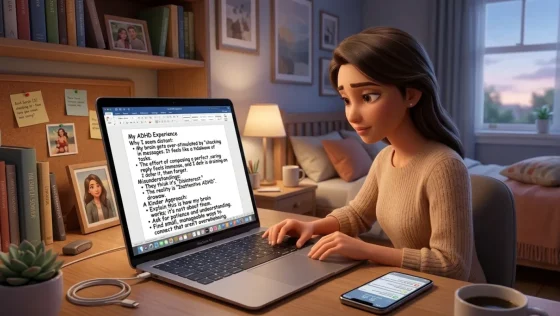
Changing Awareness Around Women and ADHD
Awareness of Attention Deficit Hyperactivity Disorder in women is changing because the old public image of ADHD symptoms was presented through the ”hyperactive, disruptive boy” stereotype, which missed many women whose symptoms are quieter, internalised, masked, or mislabelled as anxiety, depression, personality traits, burnout, or ”not trying hard enough”. Over the past decade, awareness has grown significantly, with more women now being diagnosed, especially ages 31-49.
Every time a woman says, ‘I thought it was just me,’ awareness changes.
As care providers, we have the power to make the unseen feel seen. Our role is to listen with curiosity, to ask better questions, notice the masking behind the smile, create safe spaces, offer appropriate ADHD assessment guidance and the right support, and educate families, workplaces and communities. But, most importantly, we should believe women’s experiences.
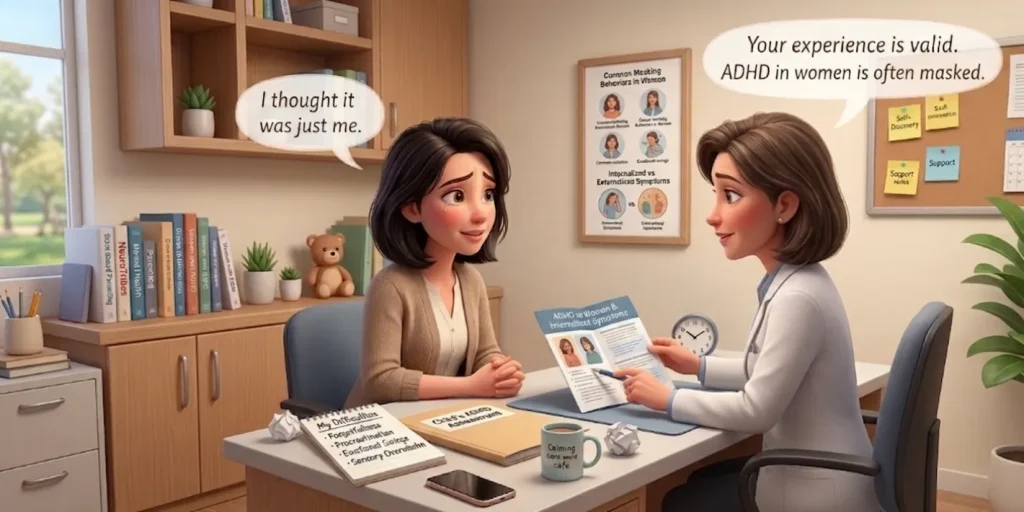
*The image is for informational purposes only. For medical advice or diagnosis, consult a professional.
Why Many Women go Undiagnosed for Years
A major point is that inattentive ADHD is less visible and can present differently in women. Clinicians and services need to move away from seeing ADHD primarily as a behavioural disorder and attend to the more subtle and internalised presentation common in females. Therefore, many women with inattentive adhd go undiagnosed for years, because it is often quiet, hidden and misunderstood. It may not look like the stereotypical image of someone who is visibly hyperactive or disruptive.
From a young age, many girls learn to mask their struggles. They may copy others, work twice as hard, stay quiet, over-prepare, or hide their difficulties out of shame. Because they are often seen as “well-behaved” or “coping”, their needs can be missed by teachers, families and even professionals. Later in life, their symptoms may be mistaken for developing anxiety, depression, chronic stress, low confidence or burnout, meaning the root cause remains unseen. For many women, diagnosis comes late, not because their ADHD was absent, but because it was overlooked.
Common Signs of Inattentive ADHD in Women
Inattentive ADHD in women can be quiet, complex and easily misunderstood. For many women, the ADHD signs have been hidden behind masking, perfectionism, caring responsibilities, or years of self-blame. Recognising them with compassion is the first step towards understanding, support and relief.
Chronic Forgetfulness and Disorganisation
For many women with inattentive ADHD, forgetfulness is the mind trying to hold too many threads at once. Keys disappear, appointments slip away, messages go unanswered, and important tasks may vanish behind the noise of everyday life. From the outside, it may look like disorganisation, but from the inside, it can feel like standing in the middle of a room full of open drawers, trying to remember what you came in for. This can be especially painful when a woman cares deeply yet still forgets birthdays, deadlines, forms, bills, or conversations. The shame can become heavier than the forgetfulness itself.
Helpful support: Gentle systems can make a real difference. Visual reminders, phone alarms, written lists, labelled spaces, calendars, baskets by the door, and “one home for important things” can reduce the pressure on memory. The goal is not to become perfectly organised, but to create a world that is kinder to the way the brain works.
Difficulty Focusing and Completing Tasks
Inattentive ADHD make focus feel bright and powerful at times, and then suddenly distant. A woman may begin with good intentions, full of ideas and motivation, but struggle to start, continue, or finish. Simple tasks can feel strangely heavy. Emails, laundry, admin, studying, work projects or household responsibilities and routines may pile up, not because she does not care, but because her brain finds it difficult to organise attention, energy and action at the same time. Sometimes she may focus intensely on one thing for hours, then find it almost impossible to switch to something else. This can create a confusing pattern: capable one moment, overwhelmed the next.
Helpful support: Breaking tasks into smaller steps can help. Instead of “clean the house”, try “clear the table.” Instead of “finish the report”, try “open the document.” Timers, body doubling, quiet workspaces, written instructions, regular breaks and realistic deadlines can support focus without relying on willpower alone. Progress still counts, even when it comes in small pieces.
Emotional Sensitivity and Overwhelm
A small mistake may echo for hours. A change in plans may feel like too much. Criticism may land deeply, even when it was not meant to hurt. Daily demands can build like waves until the nervous system feels flooded.
This emotional sensitivity is often misunderstood. Women may be called “too sensitive”, “dramatic”, or “overreactive” when they may actually be overwhelmed, overstimulated, exhausted from masking, or carrying years of feeling misunderstood.
Helpful support: Compassion is essential. Pausing before responding, taking quiet time, using grounding techniques, reducing sensory overload, naming emotions, and having safe people to talk to can help. Care providers, families and workplaces can support women by listening without judgement and recognising that emotional overwhelm is a signal that support, rest or adjustment may be needed.
Why ADHD Looks Different in Women
ADHD can look different in women because many women have spent years making it invisible, and because it was often shaped by expectations, masking, hormones, and the quieter nature of inattentive symptoms. While ADHD is still too often imagined as loud, restless or disruptive, many women experience it inwardly. From a young age, girls are often encouraged to be polite, helpful, calm and capable. Because of this, many learn to hide their struggles, copy others, over-prepare, people-please, or push themselves until they burn out. Their ADHD may be mistaken for anxiety, sensitivity, low confidence, laziness or perfectionism, rather than recognised as a real difference in attention, regulation and executive functioning.
For some women, symptoms may also become more noticeable during life changes such as puberty, pregnancy, motherhood, perimenopause or menopause, when hormones, responsibilities and stress levels shift. A woman who seemed to be “coping” for years may suddenly feel unable to keep up, not because she has failed, but because the support systems around her are no longer enough.
Inattentive ADHD and Co-Occurring Conditions
Inattentive ADHD in women does not always arrive alone. For many, it sits beside other experiences, such as anxiety, autism, OCD, eating difficulties, low mood, trauma, sensory overwhelm or burnout. This can make ADHD harder to recognise, because one condition may hide behind another. A woman may be treated for anxiety for years, supported for disordered eating, or described as perfectionistic and sensitive, while the underlying pattern of attention, executive functioning and emotional regulation remains unseen.
ADHD and Autism in Women
When ADHD and autism occur together, sometimes called AuDHD, the experience can feel like living with two different rhythms inside one mind. ADHD may seek novelty, movement, stimulation and spontaneity, while autism may need routine, predictability, sensory safety and time to process change.
In women, Inattentive ADHD and autism can be missed because symptoms may be internalised. Autistic women and girls may be seen as shy, anxious, sensitive, highly organised, socially “fine”, or simply different in subtle ways. ADHD may add forgetfulness, distractibility, emotional impulsivity or difficulty completing tasks. Together, they can create cycles of overwhelm, shutdown, burnout and self-blame.
ADHD and OCD
ADHD and OCD can seem like opposites, but they can overlap in distressing ways. ADHD may bring disorganisation, forgetfulness and difficulty sustaining focus, while OCD may bring intrusive thoughts, compulsions, reassurance-seeking or a need to reduce uncertainty. A woman may feel pulled between chaos and control, struggling to organise everyday life, while also feeling trapped by repetitive checking, rumination or perfectionistic rituals.
This pairing can be easily misunderstood. What looks like “being particular” may actually be anxiety-driven compulsion. What looks like “not caring” may be ADHD-related difficulty with attention or follow-through. When both are present, the person may feel exhausted, since one condition creates the mess, and the other panics about it.
You might be interested in reading about: The Link Between OCD and Eating Disorders
ADHD and Eating Disorders
ADHD can also overlap with eating disorders and disordered eating, especially where impulsivity, emotional regulation, sensory needs, body image pressures, shame, dopamine-seeking, routines and control are involved. Some women may forget to eat, eat irregularly, binge when overwhelmed, struggle with meal planning, or use food rules to feel in control when life feels chaotic. Others may experience cycles of restriction, impulsive eating, guilt and self-criticism.
ADHD is linked with a heightened risk of eating disorders, particularly binge eating disorder and bulimia nervosa, and clinicians need to understand and treat the interaction between both conditions. More recent research has also found increased risk of eating disorders after ADHD or autism diagnoses, with mood disorders and anxiety difficulties potentially playing an important role in that link.
ADHD Masking in Women
ADHD masking in women can look like quiet survival. Copying how others behave, over-preparing for simple tasks, apologising too often, and hiding the effort it takes to keep up often show how inattentive ADHD becomes invisible, especially when symptoms are mistaken for personality traits rather than signs ofadult ADHD. Some women describe ADHD as a search for stimulation, interest or urgency, which is often linked to the brain’s reward system and sometimes described as dopamine deficiency. This can affect motivation, focus, habits, relationships, work and social life. To others, she may seem successful and composed. Inside, she may be fighting to stay afloat.
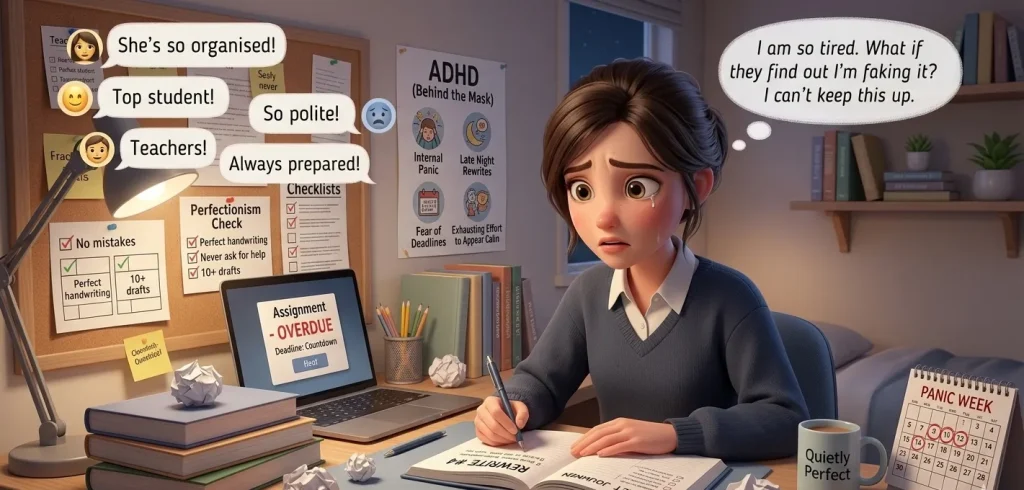
Many women develop coping mechanisms from a young age, shaped by societal expectations to be calm, capable, helpful and emotionally composed. They may write endless lists, rehearse conversations, force themselves through tasks, work late to catch up, or pretend to understand instructions when their minds have already wandered. These strategies can help them get through their daily lives, but they can also carry a heavy emotional toll.
Masking may also hide mood swings, anxiety, rejection sensitivity, negative thought patterns and deep self-doubt. A woman may live with the constant feeling of falling behind, disappointing others, or failing at things that seem easy to everyone else. Over long periods, this can lead to exhaustion, burnout and self-blame, especially when she does not yet understand that her struggles may be connected to attention, executive functioning and emotional regulation.
ADHD Burnout in Women
ADHD burnout in women can feel like the body and mind quietly saying, “I cannot keep carrying this.” And for many women with inattentive ADHD, burnout does not happen overnight. It often builds slowly through years of masking, overcompensating, people-pleasing, meeting expectations, and trying to manage life with an invisible weight that others may not see.
A woman with Inattentive ADHD symptoms may appear capable on the outside while feeling completely depleted inside. She may push herself through tiredness, hide her struggles, apologise for falling behind, or blame herself for not being able to “just get on with it.” But burnout is not laziness, weakness or failure. It is often the result of living for too long without enough support, rest, understanding or practical adjustments. Burnout can also affect cognitive function, making it even harder to think clearly, remember information, organise tasks, make decisions or regulate emotions. The very skills needed for managing inattentive ADHD can become harder to access when the nervous system is overwhelmed.
Treatment Options and Support
Treatment and support for women with inattentive ADHD should begin with a proper diagnosis, because understanding the root cause can replace years of confusion with clarity. An ADHD diagnosis can help explain patterns such as difficulty concentrating, being easily distracted, making careless mistakes, difficulty sustaining attention, or frequently seeming to daydream. From there, support may include practical strategies, workplace or study adjustments, emotional support, cognitive behavioural therapy, coaching, and, where appropriate, ADHD medications prescribed and monitored by a qualified professional.
The goal of treatment is not to change who a woman is, but to help her feel less overwhelmed in daily life. With the right guidance, managing symptoms can become more compassionate and realistic, allowing women to build routines, reduce shame, protect their energy and move towards a more balanced, confident and fulfilling life.
Neurodiversity Support with Unique Community Services
At Unique Community Services, we deliver specialist, person-centred and proactive support that recognises neurodivergence as a valuable strength to understand, nurture and build upon. Our therapy team works with people in their own homes to develop meaningful daily routines, sensory-safe spaces and personalised communication approaches that reflect each person’s needs, preferences and identity. Our flexible model of support provides consistency and stability while protecting choice, independence and personal control.
We understand that periods of change, such as moving into adulthood, leaving a school placement or recovering after a crisis, can feel particularly challenging. That is why we provide reliable, skilled, clinical care that supports people through life transitions while helping them grow, communicate and express who they are. Working closely with families, commissioners and therapists, we shape care around the person rather than expecting the person to fit into the system.
If you need support, you can always contact us here or make a direct referral to our therapy team.
FAQ
Can women develop ADHD later in life?
ADHD does not usually develop later in life, but many women only recognise or receive a diagnosis in adulthood. Symptoms may have been present since childhood but overlooked, masked, or mistaken for anxiety, stress or burnout. Life changes such as university, work, parenting or menopause can also make ADHD traits more noticeable.
Is inattentive ADHD linked to anxiety?
Yes. Inattentive ADHD is often linked to anxiety, especially when difficulties with focus, organisation, forgetfulness or time management go unsupported. Many women become anxious from constantly trying to keep up, avoid mistakes, or hide their struggles. However, ADHD and anxiety are different conditions, so proper assessment can help identify what support is needed.
How does ADHD affect women differently?
ADHD can affect women differently because symptoms are often more internalised and less obvious. Women may experience more inattentiveness, emotional overwhelm, masking, anxiety, forgetfulness, disorganisation and burnout, rather than visible hyperactivity.
