

Why Placement Stability Matters?
Placement stability is best understood as an outcome of a capable support system, rather than simply the absence of a move. There are countless reasons why it matters for complex care services, and its importance should never be excluded from the conversations healthcare professionals lead. Therefore, this points to another crucial truth: placement stability is a therapeutic, relational and safeguarding achievement that must be intentionally built and continuously protected. A lack of understanding and tailored support can worsen outcomes, so person-centred decisions and family involvement are another step towards achieving placement stability.
- It creates safety through familiarity
Consistent staff learn how the person communicates, what their usual presentation looks like and which small changes may indicate pain, illness or anxiety. That knowledge supports earlier intervention and reduces the risk of diagnostic overshadowing.
- It protects trusting relationships
For someone whose communication relies on behaviour, gestures, objects, routines or familiarity, relationships are part of the intervention. Repeated moves require the person to rebuild trust while already experiencing distress.
- It gives proactive and therapeutic support time to work
Positive Behaviour Support depends on consistent observation, functional assessment, environmental changes, skills development and reinforcement. Constant changes in staff or placement interrupt learning and make it harder to determine which strategies are effective.

- It supports identity, choice and a dignified life
A stable home allows someone to develop routines, friendships, community connections, meaningful activity and greater independence. Repeated emergency moves can remove all of these at once. The CQC’s Home for Good work found common ingredients in successful community support, principles that closely align with our own approach: genuinely bespoke care, appropriate housing, collaboration between agencies, family involvement, and understanding behaviour as a form of communication of distress or need.
- It reduces escalation into restrictive or institutional care
Placement instability does not inevitably lead to hospitalisation, but NHS policy treats imminent placement breakdown as a significant risk of admission. At the end of February 2026, the Mental Health Services Dataset recorded 3,775 people with a learning disability and/or autistic people in hospital; 29% had been there for over two years, 12% were more than 50 km from home, and 775 had been restrained at least once.
*Resource: NHS England’s February 2026 findings
- It protects families and the workforce
Stable placements reduce repeated crises, emergency advocacy and the expectation that relatives will fill gaps in commissioned care. For staff, consistency supports confidence, teamwork and retention.
Evolving Care Plan Transition vs Emergency Placement Breakdown
Placement stability does not necessarily mean remaining in the same setting indefinitely. A person’s needs, preferences and aspirations can change, and their care plan must evolve with them. Sometimes this means adapting the existing support arrangement, and at other times, a carefully planned move may offer a better quality of life.
The important distinction is between a planned transition arising from an evolving care plan and an emergency move caused by placement breakdown.
Then, when should one care plan evolve?
A review may be required when:
- Physical or mental health needs change.
- Communication, sensory, or mobility needs become better understood.
- The person develops new life skills or wants greater independence.
- Existing support levels or competencies are no longer sufficient.
- The environment no longer supports the person’s wellbeing.
- Relationships with tenants create persistent distress.
- Family carers are ageing, becoming unwell, or unable to sustain their role.
- Incident patterns, restrictions, or safeguarding concerns are increasing.
- The person consistently communicates that they are unhappy or wants to move.
Changes like these should initiate a collaborative review, not an automatic conclusion that the placement has failed.
And what should a well-managed transition involve?
- Listening to the person – Their wishes, communication style, routines, relationships and definition of a good life should guide the process.
- Understanding what has changed – The team should reassess physical health and mental health, trauma, communication, sensory needs, behaviour, and environmental factors.
- Exploring whether the current placement can adapt – Before considering a move, skilled professionals should examine whether additional therapeutic input, environmental changes, staff development or revised funding could safely sustain the placement.
- Choosing the next setting carefully – Matching should consider the provider’s actual capabilities, the environment, housemate compatibility, location, community connections and access to specialist support.
- Preparing gradually – Visits, visual information, staff shadowing, familiar items, phased introductions and consistent routines can make the new setting more predictable.
- Protecting continuity – Existing professionals, family members and trusted staff should remain involved during the transition wherever possible. Information must follow the person rather than being reconstructed after the move.
- Providing enhanced post-move support – The early weeks should include frequent reviews, rapid access to specialist help and clearly defined escalation routes.
Primary Causes of Complex Care Placement Breakdown
A complex care placement rarely breaks down because a person is simply “too complex”. More often, breakdown occurs when the support system surrounding them is not sufficiently informed, skilled, adaptable or coordinated. This can affect adults and young people receiving residential support, supported living, live-in care or specialist complex care within their own homes.
Inadequate Pre-Placement Assessments & Rushed Transitions
A successful placement begins with a thorough assessment of the whole person, perceived risks or immediate need for a vacancy. Assessments should consider:
- Physical and mental health needs
- Communication preferences
- Trauma and previous placement experiences
- Sensory needs and environmental triggers
- The possible functions of behaviours of concern
- Relationships, routines, interests and cultural identity
- Compatibility with other people in the placement
- Requirements relating to medication, mobility and personal care
- The provider’s actual capacity to meet these needs
When local authorities, integrated care boards and care providers need to arrange complex care quickly, important information may be incomplete, outdated or unavailable. The placement may then be selected according to availability rather than suitability.
Rushed transitions can make the problem worse. Moving without gradual introductions, familiar staff, accessible information, environmental visits or a detailed transition plan can create fear, uncertainty and sensory overload. For people who rely heavily on predictability and trusted relationships, an abrupt move can significantly increase distress. A transition should therefore be treated as a carefully planned therapeutic process, with contingency arrangements, rather than as a single moving date.
Staffing Mismatches & Lack of Specialised Training
A service can appear fully staffed on paper while still lacking the right combination of skills, experience, consistency and interpersonal compatibility. People receiving specialist complex care may require support from qualified carers who understand autism, learning disabilities, trauma, mental health, epilepsy, acquired brain injury, communication differences or behaviours of concern. Staff may also need competence in Positive Behaviour Support, active support, clinical procedures and recognising pain or deteriorating health.

Even when support workers have completed specialist training, classroom-based knowledge alone may not prepare them to apply that learning in practice with a particular person. Providing the right support also requires:
- Person-specific coaching and competency assessment
- Reflective supervision
- Consistent leadership
- Stable staffing teams
- Accurate communication between shifts
- Values-based recruitment
- Opportunities to learn directly from the person and their family
High staff turnover and frequent reliance on unfamiliar agency workers can interrupt trusted relationships and lead to inconsistent responses. A staffing mismatch may also arise when carers’ personalities, communication styles or expectations do not suit the person.
In live-in care, supported living, and residential services alike, continuity matters. Familiar care professionals are more likely to recognise subtle changes, understand how the person communicates and intervene proactively before distress develops into a crisis.
Unsuitable Physical & Sensory Environments
The environment is an active part of the person’s support. Noise, lighting, temperature, smells, textures, crowding, and unpredictable activity can all influence wellbeing. A placement may become unsuitable when it lacks:
- Privacy and personal space
- Access to quiet or low-arousal areas
- Appropriate lighting and noise control
- Suitable mobility or safety adaptations
- Predictable routines
- Meaningful activities and community access
- Compatible housemates
- Space for family contact
- The flexibility to adapt as the person’s needs change
People supported in their own homes can also experience environmental difficulties. Poorly designed adaptations, a lack of private space, disruptive neighbourhood noise or an unsuitable staffing presence can undermine otherwise well-planned care. The right environment should reduce avoidable demands, support communication and independence, and help the person feel safe, understood and in control.
Fragmented Multidisciplinary Communication
Complex placements frequently involve multiple organisations and professionals, including social workers, commissioners, nurses, psychologists, psychiatrists, occupational therapists, speech and language therapists, education teams, care providers and family members.
Placement stability is threatened when these contributors work in isolation. Fragmentation may involve:
- No clearly identified lead professional
- Important information being held in separate systems
- Outdated or contradictory care plans
- Disagreement about the causes of distress
- Clinical advice that is not translated into daily practice
- Families and the person being excluded from decisions
- Reviews taking place only after a crisis
- Unclear responsibility for funding or agreed actions
- Poor communication between day, night and agency staff
Without a shared understanding, different teams may respond to the same behaviour in conflicting ways. One service may view it as a mental-health issue, another as deliberate non-compliance, and another as a response to sensory distress or pain. This inconsistency can delay appropriate support and allow risks to escalate.
Strong multidisciplinary working requires a shared formulation, current and accessible plans, clearly allocated responsibilities, agreed escalation routes and regular reviews involving the person and those who know them best. Integrated care boards, local authorities, providers and other care professionals must work collaboratively rather than transferring responsibility when difficulties arise.
How Breakdown Develops
Placement breakdown rarely happens suddenly. It is usually the final stage of unmet needs accumulating, missed warning signs, and increasingly reactive support.
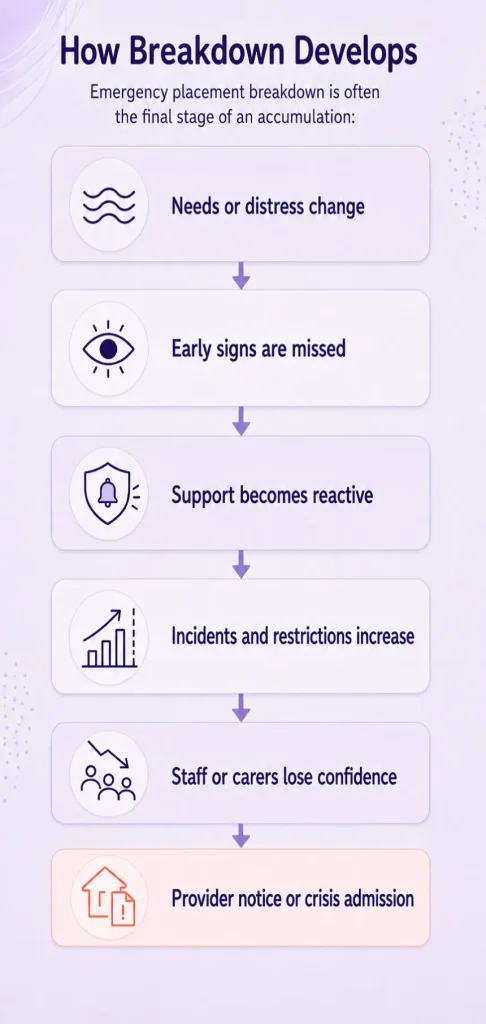
By the time notice is served or hospital admission is considered, opportunities for proactive intervention may already have been missed. This is why rising incidents should prompt questions about pain, communication, the environment and the implementation of therapeutic approaches.
And this is why it is recommended for emerging risks to be managed without automatically changing placements or increasing restrictions. It is also advisable to review care after significant changes and develop plans that support smooth transitions and outline how crises will be prevented or addressed.
How High-Quality Care Providers Prevent Placement Breakdown
High-quality care providers do more than respond when a placement reaches crisis point. They build the clinical understanding, relationships, workforce capabilities and environmental conditions needed to prevent difficulties from escalating. In specialist complex care, placement stability is not achieved by expecting the person to fit an existing service. It is created by adapting the support system around the person through nurse-led assessment, co-produced transition planning, Positive Behaviour Support and trauma-informed care.
Nurse-Led Assessments
A nurse-led assessment establishes whether a provider can safely and consistently meet the person’s needs before making a placement offer. It looks beyond diagnoses and referral documents to understand the whole person, including:
- Physical and mental health needs
- Clinical interventions
- Mobility, nutrition and personal care
- Communication preferences and sensory differences
- Trauma and placement history
- Behaviour that may communicate distress or unmet need
- Existing relationships, routines and interests
- Known risks, early warning signs and protective factors
- The skills and staffing levels required throughout the day and night
Where possible, the nurse should meet the person in their current environment and consult their family, existing care professionals and others who know them well. This helps identify discrepancies between written records and the person’s present needs. The assessment must also evaluate the provider, not only the person. A responsible provider considers whether it has the right qualified carers, specialist training, leadership, environment and multidisciplinary support to deliver the proposed care. If these capabilities are unavailable, accepting the placement may create avoidable risk.
Co-Produced Transition Plans
A successful transition is a gradual, person-centred process rather than a single moving date. Co-production means developing the plan with the person, not simply for them, while involving their family, advocates and relevant professionals. Depending on the person’s communication needs, meaningful involvement may include visual materials, photographs, social stories, videos, accessible information or visits to the new environment.
A strong transition plan should cover:
- What matters to the person
- How they communicate consent, choice, discomfort and distress
- Introductions to their future support team
- Visits at the person’s preferred pace
- Familiar routines, belongings and activities
- Medication, equipment and clinical handovers
- Sensory and environmental adjustments
- Family contact and community connections
- Early warning signs and agreed responses
- Contingency arrangements if difficulties emerge
- Responsibilities, timescales and review points
The plan should be treated as a living document. As staff learn more about the person, support should evolve accordingly.
Positive Behaviour Support (PBS)
Positive Behaviour Support helps care teams understand why behaviour occurs and how to improve the person’s quality of life and environment. Behaviour may communicate pain, fear, sensory overload, frustration, loneliness, a need for control or difficulty understanding what is happening. A PBS approach uses assessment and observation to identify:
- The purpose or function of behaviour
- Triggers and setting events
- Unmet physical, emotional, sensory or communication needs
- Early indicators of distress
- Environmental conditions that increase or reduce risk
- Skills the person could be supported to develop
- Changes staff can make to prevent escalation
Proactive strategies may include improving communication, increasing meaningful choice, adjusting demands, creating predictable routines, adapting the sensory environment and supporting access to valued activities and relationships. Reactive strategies should be clearly defined, proportionate and used only when necessary to maintain safety. Following any restraint or restrictive intervention, the provider should examine whether all proactive and therapeutic strategies were sufficiently explored and applied. Learning must then be used to improve the care plan and reduce the likelihood of recurrence.
Trauma-Informed Approach
A trauma-informed approach recognises that past experiences can influence how a person responds to relationships, environments, demands and perceived loss of control. Trauma may be associated with abuse, neglect, bereavement, restraint, seclusion, hospital admission, repeated placement changes or interactions in which the person felt frightened or powerless. Behaviour that appears resistant or confrontational may therefore be a protective response to a situation that feels unsafe.
Trauma-informed care is built around:
- Physical and emotional safety
- Trust and transparency
- Choice and control
- Collaboration rather than coercion
- Consistent, respectful relationships
- Recognition of individual strengths
- Avoidance of unnecessary re-traumatisation
The Impact of Placement Breakdown
Placement breakdown can have a profound effect on a person’s emotional wellbeing, physical health and sense of security. An unplanned move may mean losing familiar carers, routines, relationships and community connections, causing distress, confusion and a loss of trust in care professionals. It can also interrupt therapies and personal care, while increasing the risk of restrictive interventions, emergency-service involvement or hospital admission.
Families may experience anxiety, exhaustion and renewed caring responsibilities, while staff can face burnout, reduced confidence and moral distress. Integrated care boards, local authorities and providers must then urgently arrange complex care, often at greater cost and with fewer suitable options. This pressure can result in temporary, distant, or more restrictive placements selected based on availability rather than compatibility.
One breakdown can make another more likely. Previous incidents may come to define the person, discouraging providers from offering support and obscuring the system failures that contributed to the breakdown. Preventing this cycle requires skilled, coordinated and person-centred support that protects the person’s safety, rights, relationships and quality of life.
What to Do When a Placement is at Risk
When a complex care placement becomes unstable, the priority is to intervene early, understand what has changed and strengthen the support around the person. The objective is to prevent an apreventn emergency that can be avoided while protecting the person’s safety, rights, relationships and wellbeing.
🗣 Recognise and escalate the warning signs: Concerns should be raised as soon as there is evidence of increasing distress, incidents, restrictive intervention, staff turnover, family exhaustion, unmet health needs or the provider reporting that it can no longer meet the person’s needs.
🗣 Request an urgent multidisciplinary review: In England, the person, their carer, family member, advocate or the local authorities can request a review of the care and support plan. A change in needs or circumstances may also trigger an unplanned review by the local authority. For young people, the meeting may also need to involve children’s social care, education representatives, the SEND or EHC plan team, paediatrics and mental health services.
🗣 Reassess what is driving the instability: The team should avoid assuming that increased distress is simply part of the person’s condition. A renewed assessment should consider pain, illness, changes in mental health or emotional wellbeing, trauma-related triggers, changes in carers, routines, insufficient staffing, gaps in specialist training, or whether the behaviour support plan remains accurate.
🗣 Agree a written placement-stabilisation plan: The multidisciplinary team should produce a time-limited plan with named owners, deadlines and review dates. Depending on the findings, this might include additional or more consistent qualified carers, updated Positive Behaviour Support, health and risk-management plans, flexible or emergency funding, short breaks or support from family carers etc.
🗣 Escalate immediate safety or safeguarding concerns: If there is suspected abuse, neglect, unsafe care, inappropriate medication or excessive restriction, a safeguarding concern should be raised with the relevant local authority. Under the Care Act, the authority must make, or arrange, enquiries when the adult meets the statutory safeguarding criteria. Providers should also follow their notification duties to the CQC.
Safe Transitions and High-quality Care with Unique Community Services
At Unique Community Services, a safe transition is a carefully coordinated journey towards a meaningful life in the community.
Through our rights-based, person-led Bridging Support model, experienced teams begin working before discharge, collaborate with families, commissioners, clinicians and housing partners, and remain alongside the person throughout their move and stabilisation.
By matching the right team, shaping the right home and gradually reducing front-loaded support only as stability grows, we create the conditions for people not only to come home, but to stay home and thrive.
We supported Jane to transition from hospital to home, after spending 9 months surrounded by a high staffing ratio.
When we met Jane, we were there to create the most suitable plan to help her transition out of the hospital and back to her home environment. That way, she’d be able to build a more independent lifestyle and return to education. – Aimee Rossbottom, Unique Community Services’ Assistant Registered Manager
Read more about care after hospital discharge and what families need to know.
Offices: Manchester and Leeds
